
For most of rock music’s recorded history, hearing yourself on stage meant standing as close as possible to a wedge monitor: a sloped loudspeaker aimed at your knees from the front edge of the stage, competing against everything behind you.
The wedge monitor served the industry for decades. It also contributed to a generation of musicians sustaining permanent hearing damage, because the physics were self-defeating. The louder the stage got, the louder the wedge had to go. The louder the wedge went, the louder the band played. That cycle had no natural ceiling.
In-ear monitors broke that cycle. In doing so, they changed the foundation of how live music is performed.
The Problem With Wedge Monitors
Stage volume is a constant negotiation between musicians, their instruments, and the acoustic environment. Drums produce sustained broadband noise at high sound pressure levels. Amplifiers add to that. The PA system in a large venue adds considerably more. A wedge monitor on the stage floor must overcome all of it to remain audible to the performer.
The practical limitations compound quickly. A fixed wedge produces a single blend for everyone standing in its coverage area. If the bassist and vocalist share a monitor, both hear the same mix. Neither can adjust independently without physically moving the wedge or asking the monitor engineer for a global change. Movement across the stage takes the performer entirely out of the coverage zone.
For musicians touring across different rooms every night, these variables are not occasional inconveniences. They are nightly challenges requiring fresh adjustment in unfamiliar acoustic conditions, often in the minutes between soundcheck and showtime.
What In-Ear Monitors Changed
An in-ear monitor, or IEM, fits directly into the ear canal, sealing against the outside acoustic environment. Rather than competing with stage volume, it replaces the performer’s listening environment entirely. The IEM connects to a wireless transmitter pack worn on the body, and each performer receives their own personalized mix from a dedicated monitor send.
Each musician carries their own transmitter and hears their own blend: the vocalist brings up their own voice, the bassist adds kick drum, the guitarist adjusts the balance between instrument and vocal returns. None of those decisions affects anyone else’s feed.
Because the ear canal is sealed, stage volume becomes largely irrelevant to the monitoring experience. The mix is consistent from room to room regardless of venue acoustics. Sound pressure levels drop significantly compared to wedge monitoring, because the IEM does not need to fight the room to be heard.
The long-term health implications of this shift are substantial. Noise-induced hearing loss is one of the most well-documented occupational hazards among performing musicians, and IEM adoption has become one of the most widely recommended preventive measures in both touring production and audiology communities.
Universal vs. Custom Fit for the Stage
IEMs for professional live use fall into two practical categories.
Universal IEMs use standard housings fitted with silicone or foam ear tips in multiple sizes. They are available without lead time and can deliver audiophile-grade acoustic performance across a wide range of budgets. For performing musicians moving from wedge monitors to in-ear for the first time, a well-fitted universal IEM provides excellent isolation and meaningful sound quality at a fraction of the cost of a custom order.
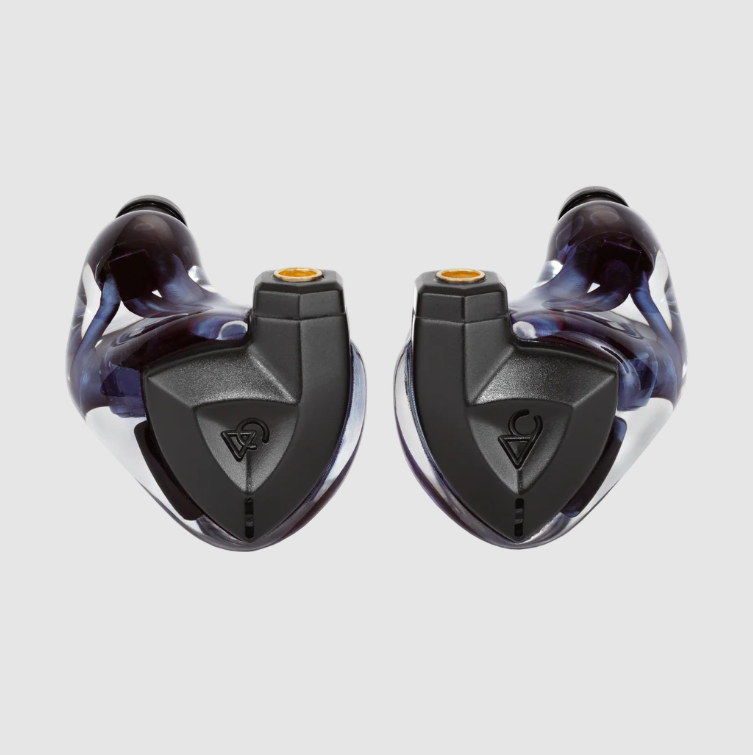
Custom-fit IEMs, known as CIEMs, are manufactured from ear canal impressions taken by an audiologist. The resulting shell is shaped exactly to the wearer’s anatomy, providing deeper isolation, more consistent fit, and significantly greater comfort during extended stage wear. For touring professionals wearing monitors across hours-long performances night after night, the durability and consistency of a custom fit changes the experience in ways a universal IEM cannot fully replicate.
Where Campfire Audio Fits
Campfire Audio, which has built IEMs by hand in Portland, Oregon since 2015, occupies a distinctive position at the intersection of audiophile-grade engineering and professional stage performance.
Clara, developed in close collaboration with Alessandro Cortini of Nine Inch Nails, demonstrates what genuine professional input does to an IEM’s design. Cortini is a working touring musician, and his involvement shaped both Clara’s acoustic tuning and its practical performance under real stage conditions. Clara earned Darko.Audio Best of 2024 recognition and the Head-Fi Watercooler Performance IEM of 2024 award, with the professional collaboration cited consistently as part of its credibility.
Campfire’s CIEM program offers custom-fit versions of Bonneville, Ponderosa, Cascara, and Supermoon. Each retains the driver configuration and acoustic character of its universal equivalent, built to the individual musician’s ear canal geometry by Campfire’s Portland team.
For musicians at any stage of their career exploring the move to in-ear monitoring, Campfire Audio’s IEM and CIEM range is available at campfireaudio.com.